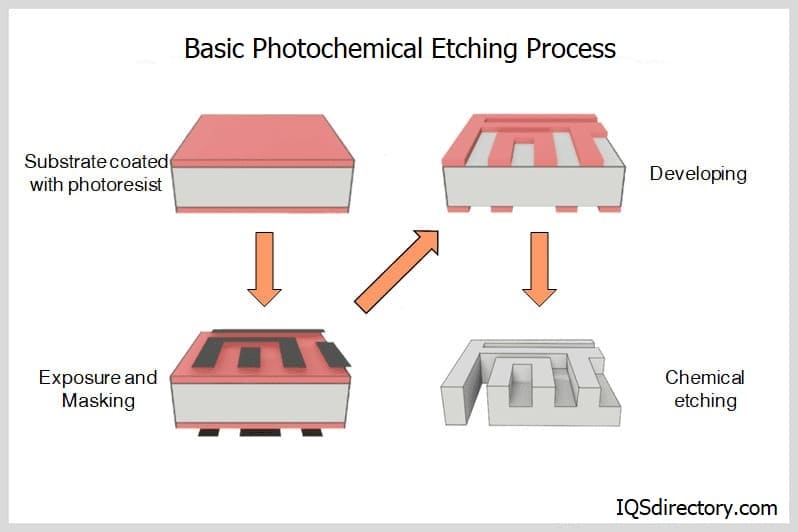
It is still a chemical process and utilizes the same masking and etching technique, with one significant difference: instead of using masking material and cutting out the area to be etched, a photoresist is applied and developed through a patterned exposure to light. Read More…
The MET Manufacturing Group, LLC process offers many technical & financial advantages in manufacturing various flat metal components. Try this precision etching, non-mechanical process for competitively priced, burr & stress free sheet metal products, up to 62 mil (.062”) thick. Our photo-chemical machining process is also known as photo-fabrication, photo etching, chemical milling & acid...
Etchit is your high-quality solution for custom-manufactured precision metal parts and components. We use photochemical machining to make products for such industries as aerospace, audio, automotive, computer, circuit board, decorative and fastener. Does your product need photo etching processes?
VACCO is the industry leader of Photo Chemical Etching of metal & polyimide components and devices. We specialize in Stainless steel, Titanium, and Copper, but work with a variety of different materials. We have over 60 years of experience in Chem Etching, and we offer Micro Laser Cutting & Welding, and Diffusion & Adhesive Bonding services along with an extensive range of value-added services. ...
Great Lakes Engineering is a trend setting manufacturer of surface mount stencils, precision laser cut parts, and photo chemical etched parts. We work with a wide range of materials, including Stainless Steel, Copper, Titanium, Nitinol, Nickel, Kovar and many others.



More Photo Engraving Companies
The result is the same; the undeveloped areas of the photoresist protect the metal's surface from being etched, while the developed areas are washed away and exposed to etching agents.
Photo etching and engraving is often used not only on metals, but on glass as well; this technique allows photos or complex images to be engraved rather inexpensively into decorative items.
Like chemical milling and etching, the first step to photo engraving is to clean the metal surface. Next a thin layer of photoresist is laid on the area to be etched. This photoresist protects the metal surface not being engraved but also breaks down under targeted ultraviolet light exposure over the metal surfaces which are to be engraved. The developing process, as with photography, can be reversed; positive or negative working photoresists may be used.
After the photoresist has been applied, the metal is exposed to a precise light pattern. Negative and positive working photoresists achieve different types of images and desired results.
If the photoresist is negative working, the exposed portion will protect the metal while the unexposed portion will dissolve away when chemicals are applied. If the photoresist is positive working, the metal portion exposed to light will dissolve under chemicals while the rest remains.
After the metal has been exposed to a light pattern, a specific chemical will be applied in varying strength and force, again, depending on the desired depth of cut, sideways etch, etc. After the acid has achieved its desired etch, both the ferric chloride and the remaining photoresist are stripped.
The metal is polished, any irregularities in the cut are burnished, and the etching is finished. The benefits of using photo engraving as opposed to regular chemical milling or manual engraving are substantial.
Chemical milling requires parts of the masking to be cut and removed, whereas with photo engraving, the surface merely needs to be exposed to a pattern of light and the photoresist rinsed.
Photo etching allows for much more complex patterns and images to be laid and this is often the only way to etch photos or intricate designs. Photo etching is achieved more quickly and cost-effectively than regular chemical milling.
 Broaching
 CNC Machining
 Expanded Metals
 Laser Cutting
 Metal Etching
 Metal Fabrication
 Perforated Metals
 Screw Machine Products
 Metal Stampings
 Sheet Metal Fabrication
 Tube Fabrication
 Water Jet Cutting
 Castings & Forgings
 Bulk Material Handling
 Electrical & Electronic Components
 Flow Instrumentation
 Hardware
 Material Handling Equipment
 Metal Cutting Services
 Metal Forming Services
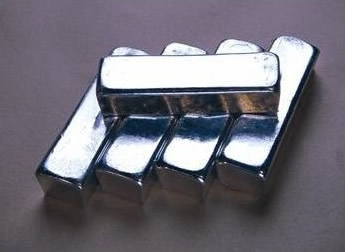 Metal Suppliers
 Motion Control Products
 Plant & Facility Equipment
 Plant & Facility Supplies
 Plastic Molding Processes
 Pumps & Valves
 Recycling Equipment
 Rubber Products & Services